
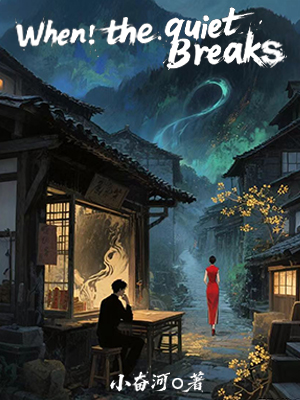
Chapter 4 When the Yin Soldiers Pass Through
Night finally fell.
I sat by the window on the second floor of the paper-effigy shop, the world around me sunk in deathlike silence. Only the festering wound on my left hand throbbed and itched with growing intensity, as if countless tiny insects were crawling freely beneath my skin.
Lu Yaqi moved calmly through the shop below, locking the front door tight and sliding the heavy wooden bolt into place. She wore a long white dress, her hair spilling loosely over her shoulders. Under the dim, yellowed lamplight, her figure cast a hazy shadow—seen from a distance, she looked almost unearthly, like an immortal untouched by the dust of the mortal world.
“Remember,” she said before leaving, lowering her voice once more, “don’t look until I come for you. When the yin soldiers pass through, there are certain hours when seeing them is forbidden.”
Her tone was cool and firm, not advice but an order—one that could not be disobeyed.
I had every intention of doing as I was told. Then, without warning, the shrill cry of a suona rose from the street below, tearing through the stillness.
The sound was piercing, mournful to the extreme—half sob, half wail—like funeral music drifting up from the depths of the underworld. It sent a chill straight into my bones. Curiosity got the better of me. I edged closer to the window and peeked outside.
The townsfolk were already in a panic, shutting doors and bolting windows as if startled birds scattering at the first sign of danger, afraid that a moment’s delay might draw something unspeakable to their homes. Even the stray dogs that usually strutted about the street corners now fled with their tails tucked, vanishing into dark alleys and leaving the road eerily empty.
The suona drew nearer.
I turned my head and stared—and nearly cried out.
A wedding procession was emerging slowly from the street corner, every figure dressed in bright red bridal robes. But on closer look, the embroidered character for double happiness was wrong—xi, written upside down, twisted into the shape of the character for mourning. The sight was deeply unsettling.
The bearers held iron pitchforks, and from each prong hung small bronze bells that chimed softly as the procession advanced, their clear notes carrying an icy edge. Yellow ritual banners whipped violently in the wind, painted with talismans known as Five Ghosts Bearing Wealth. Time had faded the cinnabar ink, revealing beneath it a single character written in corpse oil: Grievance. A thick, greasy stench rose into the air, mingled with rot, making my stomach churn.
The faces of the procession members were painted corpse-white, their frozen smiles grotesque in the gloom.
At the front walked a shaman clad in strange ceremonial garb, holding a yellow command flag high above his head. He chanted loudly in a voice that echoed down the street:
“Where yellow banners spread, white banners fly.
The five dragons stir—the yin soldiers arrive.
Drums and horns sound; the wronged return for their due.”
His chant blended the keening funeral melodies of the Miao highlands with the corpse-driving incantations of western Hunan. Each time he finished a line, a drop of black blood fell from the tip of his banner.
The blood struck the ground and, in an instant, turned into finger-thick black snakes. They writhed and scattered across the street, twisting through the darkness, a sight so chilling it made my scalp prickle.
Staring at the scene before me—so grotesque it bordered on the unreal—I couldn’t help thinking to myself:
This doesn’t feel like yin soldiers at all.
Just then, a scent crept into the air—sandalwood tinged with blood, mixed with the acrid burn of smoldering joss paper. It grew thicker by the second. My left hand suddenly spasmed as if seized by some unseen force, convulsing violently beyond my control. In my palm, dark red lines slowly surfaced, forming the pattern of the Big Dipper. The marks pulsed faintly, as though alive, flickering with an ominous glow.
At once, the shrieking suona cut off mid-note.
Silence fell—absolute and suffocating, as if the world itself had been muted.
At the same time, a dense fog rolled in from nowhere, surging down the street like a tide and swallowing everything in its path.
I remained frozen by the window, scarcely daring to breathe. Then I heard it—measured, powerful footsteps approaching from afar, accompanied by the clatter of iron chains dragging across the ground. Each sound landed on my chest like a hammer blow.
Out of the fog emerged a formation of “soldiers,” marching in perfect unison, clad in armor from the Ming dynasty.
Their faces were sealed behind bronze masks, leaving only two hollow eye sockets—dark voids that seemed capable of sucking in a man’s soul. At each soldier’s waist hung a string of bronze bells, their distant, drifting chimes sounding as though they came straight from the underworld. They slipped unannounced into the ear, sending a cold shiver down the spine.
What truly made my scalp crawl was the inscription carved into their armor.
Embroidered Guard.
—or so it seemed at first glance.
On closer look, the characters read: Paper-Clad Guard.
They cast no shadows. Their bodies were half-transparent, as though shaped from the fog itself—present, yet not entirely real.
At the center of the procession, four of the Paper-Clad Guards carried a blood-red sedan chair. A gust of yin wind lifted the curtain, revealing the figure seated inside.
The moment I saw his face, my heart nearly shattered.
It was my father.
I opened my mouth to call out to him, but it felt as if an invisible hand had clamped down on my throat. No sound would come. My father slowly turned his head. The face I once knew so well had rotted away by half, reeking of decay. On his left hand was a festering wound—identical to mine—pus and blood oozing endlessly from it.
He reached out toward me, his cracked lips trembling. As his hand extended, his palm split open with a wet tear, black-red blood pouring out and dripping onto the sedan chair below.
Terror overwhelmed me. I slammed the window shut and collapsed to the floor, my heart pounding wildly, as if it were about to burst through my chest.
That was when Lu Yaqi’s voice spoke from behind me.
I had no idea when she had appeared.
Her face was dark, heavy as a storm about to break. She said coldly,
“I knew you wouldn’t listen. I knew you’d look.”
Then she added, her voice low and grim:
“Two of the yin soldiers are already heading straight for our shop.”
She was holding a peachwood sword in her hand, its blade smeared with black blood. The viscous liquid crept slowly down the wood, releasing a sharp, metallic stench.
“This is called yin soldiers borrowing the road,” she said in a low voice, her expression grave. “Every year during the Ghost Festival, the souls of those who died unjustly are escorted by the yin soldiers to the underworld for judgment. It’s the rule of the nether courts.”
As she spoke, she handed me a bowl of talisman water. A few withered, yellowed locust leaves floated on the surface. The liquid shimmered faintly, yet it gave off a bloodlike, rusty smell that turned my stomach.
“Drink it,” she said coldly. “It will temporarily mask your living breath.”
I hesitated, staring at the bowl of foul-smelling liquid, my throat tightening. But given the situation, I clenched my teeth, pinched my nose, and swallowed it in one gulp. The moment it touched my tongue, a sharp, needle-like pain shot through my mouth, leaving me utterly miserable.
Seeing that I had finished it, Lu Yaqi nodded in satisfaction. She moved to the window and leaned out slightly, pointing at the retreating procession outside.
“When yin soldiers borrow the road, nothing is more taboo than being seen by the living,” she whispered. “Stay upstairs, hold your breath, and they won’t sense you. As for me—I’ll have to make a trip to the underworld with them.” She let out a short sigh. “Honestly, you’ve really dragged me into this.”
After a pause, she added quietly, her gaze fixed on the fog outside, “But once I’m gone, tonight won’t be peaceful.”
“Why?” I asked at once, my heart pounding uneasily.
“Yin soldiers only appear during the Ghost Festival,” she said, frowning. “Yet tonight, they’ve come early. That means a vengeful spirit is at work—and judging by this anomaly, its resentment runs deep.”
“What should I do? You’ll be all right going with them, won’t you?” The thought of such a powerful, wronged soul nearby sent my heart straight to my throat.
“Don’t worry,” she said, her tone easing slightly. “That’s not for you to handle. Still, by the looks of it, this will be a sleepless night.”
She reached into her robe, pulled out a yellow talisman, then took a cinnabar brush and began to write swiftly. The brush danced across the paper, producing a soft scratch-scratch as lines of crimson symbols took shape.
“What’s that?” I asked, leaning closer.
“A soul-suppressing talisman,” she replied, handing it to me. “It can hold off a resentful spirit for a short while. Paste it on the door—it might keep you safe through the night.”
Soon after, two ghostly enforcers stepped forward. Lu Yaqi went downstairs, exchanged a few words with the yin soldiers in hushed, cryptic phrases, and then followed them away.
I stayed perfectly still, barely daring to breathe. The procession gradually receded, the footsteps and bronze bells fading into the night. When all seemed quiet, I cracked the window open slightly and looked out again.
The fog had thickened even more, layering itself like heavy white curtains. The world beyond was almost completely swallowed—no more than an arm’s length was visible.
Clutching the talisman, I hurried to the door and carefully pressed it onto the wooden panel. The instant it made contact, the door shuddered violently—thump, thump, thump—beating like a frantic heart. It felt as though something powerful and malignant was thrashing just outside, desperate to force its way in.
“Ah—!” I nearly cried out.
Before I could recover, something dropped from the ceiling beam with a sharp whoosh. I looked up just in time to see a snake twisting in midair. Before it even hit the ground, it collapsed into a heap of ash and vanished.
In that instant, it dawned on me.
Wasn’t this the same kind of snake that had fallen from the yellow banners earlier?
Comments
0