
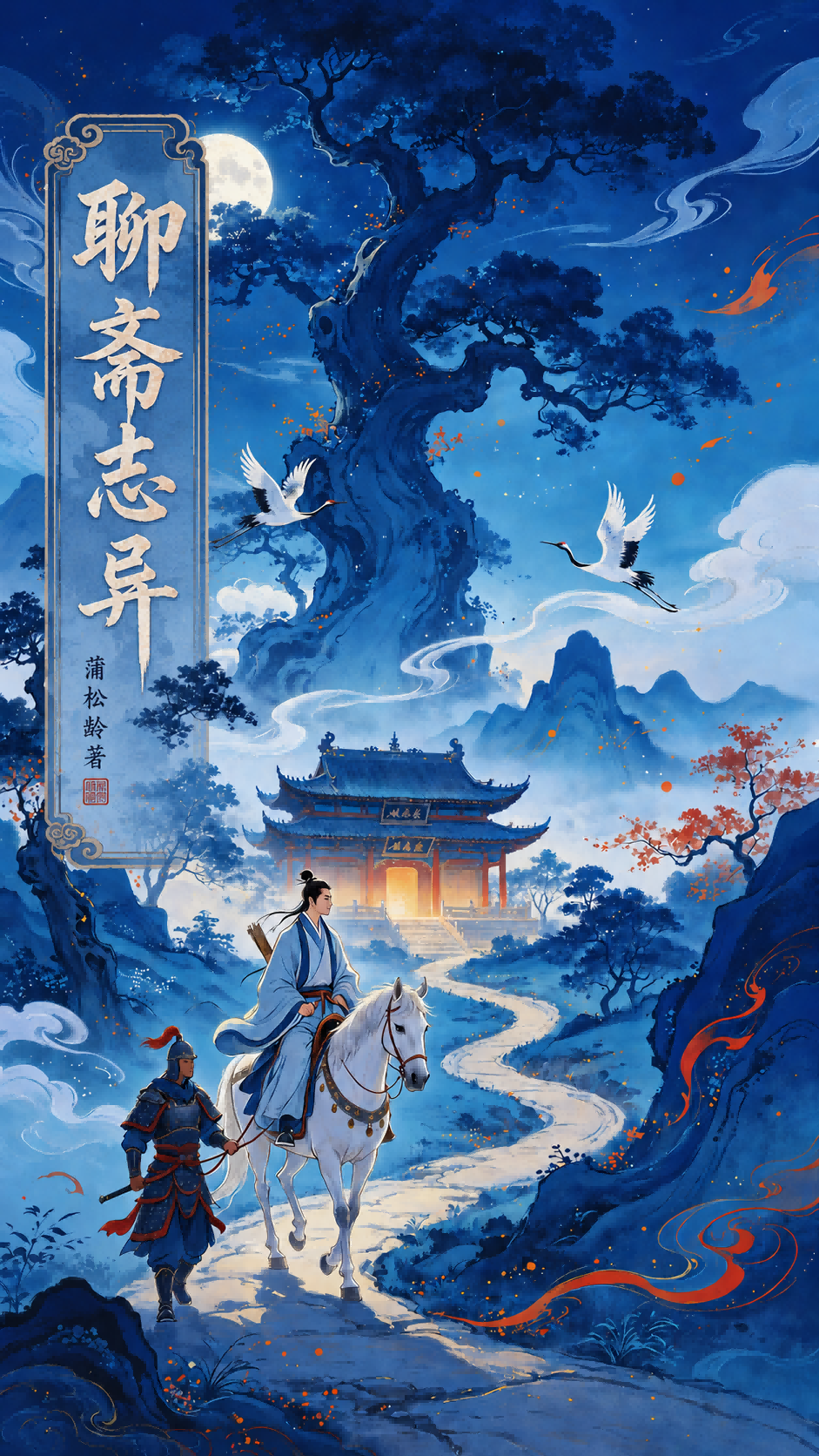
Nie Xiaoqian
Ning Caichen, a native of Zhejiang, was a man of generous and straightforward character, upright and scrupulous in his conduct. He often said to others, "In all my life, I have never looked twice at any woman." It happened that he was traveling to Jinhua. When he reached the northern outskirts, he unpacked his luggage at a Buddhist temple. The halls and pagodas of the temple were magnificent, but the brambles and weeds were as tall as a man, as if no one had set foot there for ages. The monks' quarters on the east and west sides stood with their double doors ajar. Only a small room on the south side was locked with what looked like a new bolt. Looking toward the eastern corner of the main hall, he saw tall bamboos, thick as a man's arm, and below the steps a large pond where wild lotus was already in bloom. He was quite pleased with the secluded and quiet atmosphere. It happened that the provincial examiner was then in the city conducting examinations, and lodgings were expensive. Thinking he would stay here, he strolled about waiting for the monks to return.
As dusk fell, a scholar arrived and opened the south door. Ning hurried over, greeted him, and told him of his intention. The scholar said, "There is no caretaker here. I am only a lodger myself. If you can put up with the desolation, and will honor me with your company mornings and evenings, I should be most fortunate." Ning was delighted. He spread some straw for a bed, propped up a board for a table, and prepared for a long stay. That night, the moon was bright and high, its pure light like water. The two men sat knee to knee in the temple corridor and exchanged names. The scholar said, "My surname is Yan, my given name Chixia." Ning took him for a candidate for the provincial examinations, but his accent was not at all like that of Zhejiang. When asked, he said he was from Shaanxi. His speech was simple and honest. After they had talked until they had nothing more to say, they bowed and parted to retire for the night.
Ning, being in a new place, lay awake for a long time. He heard whispering from the north side of the house, as if there were a family living there. He rose and peered through a stone window in the north wall. Beyond a low wall he saw a small courtyard, where a woman of about forty and an old woman in a faded red dress, with silver combs in her hair and a bent, aged back, were talking in the moonlight. The woman said, "Why hasn't Xiaoqian come for so long?" The old woman said, "She should be here soon." The woman asked, "Has she been complaining about you, Auntie?" The old woman replied, "I haven't heard anything, but she seems a little unhappy." The woman said, "That girl shouldn't be treated too well!" Before she had finished speaking, a girl of seventeen or eighteen arrived, whose beauty was breathtaking. The old woman laughed and said, "We shouldn't gossip behind people's backs. We were just talking about you, you little witch, and you come creeping up without a sound. Fortunately we didn't say anything bad about you." She went on, "You are as pretty as a painting. If I were a man, I'd be bewitched too." The girl said, "If you don't praise me, Auntie, who will?" Then the woman and the girl said something more, which Ning could not make out. He assumed they were the women of a neighbor's household and went back to bed, not listening further. After a while, all fell silent.
He was just about to fall asleep when he felt someone enter his room. He rose quickly and looked—it was the girl from the north courtyard. Startled, he asked what she wanted. The girl smiled and said, "On this moonlit night I could not sleep, and I wished to offer you my company." Ning replied sternly, "You should guard against the talk of others, and I fear the gossip of men. One false step, and honor and decency are lost." The girl said, "No one will know, in the dead of night." Ning scolded her again. She hesitated as if to say more, but Ning cried out, "Go quickly! Otherwise I shall call the man in the south room!" Frightened, she withdrew. Outside the door she turned back and placed a gold ingot on his mat. Ning snatched it up and flung it into the courtyard, saying, "Ill-gotten goods—do not defile my bag!" Ashamed, she left, picked up the gold, and murmured to herself, "This man must be made of iron and stone."
The next morning, a scholar from Lanxi arrived with a servant to await the examinations. They lodged in the east wing. That night, the scholar died suddenly. On the sole of his foot was a small hole, as if made by an awl, from which a thin trickle of blood oozed. No one knew the cause. The next night, the servant also died, with the same symptoms. Toward evening, Yan Chixia returned, and Ning questioned him about it. Yan believed it was the work of a demon. Ning, who was by nature resolute and upright, was not much concerned.
At midnight, the girl appeared again and said to Ning, "I have seen many men, but never one with a heart as iron-hard as yours. You are truly a sage, and I dare not deceive you. My name is Nie Xiaoqian. I died at eighteen and was buried beside this temple. Since then I have been threatened by evil spirits and forced to perform these base services, making a shameless show of myself—something I never wished to do. Now there is no one left in the temple for me to kill, and I fear the yaksha will come." Ning was terrified and begged her for a plan. The girl said, "If you share a room with Yan Sheng, you can escape." He asked, "Why don't you try to seduce him?" She replied, "He is an extraordinary man. I dare not approach him." He asked, "How do you entrap people?" She said, "Those who grow intimate with me—I secretly prick their feet with an awl. They become dazed and confused, and I drain their blood for the demon to drink. Or I use gold—not real gold, but the bones of a rakshasa. If it is kept, it can cut out a man's heart and liver. Both methods are used to suit the victim's tastes." Ning thanked her. He asked when he should be on guard, and she said, "Tomorrow night." As she left, she wept and said, "I have fallen into a dark abyss and cannot find the shore. You, sir, are a man of righteousness who could lift me from this suffering. If you would gather my bones and bury them in a peaceful place, it would be as if you had given me new life." Ning firmly promised. He asked where she was buried, and she said, "Just remember—under the white poplar with a crow's nest on it." She went out the door and vanished.
The next day, fearing that Yan might go out, Ning went early to invite him to his room. After breakfast, he prepared wine and food and carefully observed Yan. He asked Yan to spend the night with him, but Yan declined, saying he was used to solitude. Ning insisted and brought his bedding over. Yan had no choice but to move his bed and comply. He warned Ning, "I know you are a true man, and I admire you greatly. But I have some private matters I cannot yet explain. Please do not pry into my bags and boxes. If you do, it will be bad for both of us." Ning respectfully agreed.
They both lay down to sleep. Yan placed his box on the windowsill. Before long, he was snoring like thunder. Ning could not sleep. Near the first watch, a shadowy figure appeared outside the window. It soon came close and peered in with flickering eyes. Ning was frightened and was about to call out to Yan when something burst from the box—a flash of white like a bolt of silk. It struck the stone window frame, shattering it, and shot out, then instantly withdrew, as fast as lightning. Yan awoke and sat up. Ning pretended to be asleep and watched. Yan took out an object from the box and examined it by moonlight, sniffing and looking. It was white and glittering, about two inches long and as wide as a chive leaf. He wrapped it carefully in many layers and put it back in the broken box, muttering, "What old demon is so bold as to damage my box?" Then he lay down again. Ning, amazed, rose and questioned him, telling him what he had seen. Yan said, "Since we trust each other, I should not hide it. I am a swordsman. If it were not for the stone frame, the demon would be dead. Even so, it has been wounded." Ning asked, "What was that thing you wrapped up?" "My sword," Yan said. "I just sniffed it—there is demonic taint on it." Ning asked to see it, and Yan generously showed him—a small, gleaming sword. From then on, Ning held Yan in even higher regard.
The next day, Ning saw bloodstains outside the window. He went north of the temple and found a field of graves. Among them was a white poplar with a crow's nest at the top. Having made his plans, he packed his things and prepared to go home. Yan prepared a farewell feast, warm and generous in friendship. He gave Ning a worn leather pouch, saying, "This is a sword-case. Keep it well—it will keep demons and spirits at a distance." Ning wished to learn his arts. Yan said, "A man of your integrity and courage could indeed practice this art. But you are destined for wealth and rank, not for this path." Ning then pretended that he had a sister buried there, unearthed the girl's bones, wrapped them in a robe, and hired a boat to return home.
Ning's study was near the countryside, so he buried the bones outside it. He offered a sacrifice and prayed, "I pity your lonely soul. I have buried you near my humble home, so that your songs and tears may be heard, and that you may not be bullied by fierce spirits. A bowl of thin wine I offer—not very fine, but I hope you will not disdain it." Having prayed, he turned back. Someone called, "Wait—let me go with you!" He looked back and saw Xiaoqian. She thanked him with joy, saying, "Your faith and honor are such that even ten deaths would not repay you. Please take me to meet your parents. I would be content to serve as a maid or concubine." He looked at her more closely. Her skin glowed like rosy clouds, her feet were delicate as tender shoots, and in the daylight her beauty was even more radiant. Together they went to his house. He asked her to wait a moment while he went in to tell his mother, who was astonished. His wife had been ill for a long time, and his mother warned him not to speak of it, fearing she might be alarmed. But before he had finished speaking, Xiaoqian had already entered gracefully and knelt before her. Ning said, "This is Xiaoqian." His mother gazed at her in astonishment. Xiaoqian said, "I am a lonely soul, far from my parents and brothers. Thanks to your son's great kindness, I wish to serve him and repay his virtue." Seeing her graceful and lovely, the mother at last dared to speak. "You honor my son, and I am truly glad. But I have only this one son, to carry on the family line. I dare not let him take a ghost for a wife." Xiaoqian said, "I have no ill intentions. If you cannot trust a woman from the underworld, let me be your adopted daughter, to attend on you morning and evening. Would that do?" The mother, moved by her sincerity, agreed. Xiaoqian then wished to see her new sister-in-law, but the mother excused her on account of illness, and so she did not. Xiaoqian went into the kitchen and took over the cooking. She moved about the rooms as if she had lived there long.
At dusk, the mother, still afraid, sent her away to her own quarters and did not prepare a bed for her. Xiaoqian understood her mind and left. She passed by the study and would have entered, but drew back, lingering outside as if in fear. Ning called to her. She said, "The room has the aura of a sword—it frightens me. That is why I did not come to see you on the road." Ning realized it was the leather pouch, took it down, and hung it elsewhere. Only then did Xiaoqian enter. She sat by the lamp. For a long while she said nothing. At last she asked, "Do you read at night? When I was young, I recited the Surangama Sutra, but now I have forgotten most of it. Might I borrow a copy, and in my spare time ask you to correct me?" Ning agreed. She sat on in silence. The second watch was nearly over, and she did not leave. Ning urged her. She said sadly, "I am a lonely soul in a strange land—I am terribly afraid of the desolate grave." Ning said, "There is no other bed here, and as brother and sister, we should keep our distance." She rose, her brows knit in sorrow, her steps lingering, and slowly left the room, descending the steps and disappearing. Ning privately pitied her and thought of letting her stay in another room, but feared his mother's displeasure.
Every morning, Xiaoqian attended on his mother, brought water for her to wash, and did all the household chores, always following her wishes. At dusk she would withdraw and come to the study, reading the sutra by lamplight. When she saw that Ning was about to rest, she would leave sorrowfully.
Ning's wife had long been ill and bedridden, and his mother was worn out with labor. Since Xiaoqian came, she had been much eased, and felt grateful to her. As time passed and they grew more familiar, she came to love Xiaoqian as her own daughter, forgetting she was a ghost, and could not bear to send her away at night. She kept her to sleep in her own room. At first Xiaoqian ate nothing. After half a year, she began to take a little gruel. Mother and son both doted on her, never speaking of her being a ghost, and others could not tell the difference.
Before long, Ning's wife died. The mother secretly wished to take Xiaoqian as his wife, but feared it might harm him. Xiaoqian, who guessed her thoughts, took the chance to say, "I have been here more than a year; you must know my heart by now. I came with your son only because I wished to harm no more travelers—that is all. I have no other motive. It is simply that your son is so open and upright, admired by gods and men alike, that I wished to stay by his side for a few years, so that I might win honor and bring light to my grave." The mother knew she meant no harm, but still feared she could not bear children. Xiaoqian said, "Children are granted by Heaven. Your son is destined to have three sons who will bring glory to the family. That will not be taken from him because he has a ghost for a wife." The mother believed her and discussed it with her son. Ning was delighted, and a feast was spread to announce it to their relatives. Some asked to see the new bride. Xiaoqian appeared in full dress, and everyone was astonished—not suspecting she was a ghost, but thinking she must be an immortal. All the women of the clan came with gifts to congratulate her and vied to make her acquaintance. Xiaoqian was skilled at painting orchids and plums, and she often gave her paintings in return for gifts. Those who received them treasured them as great honors.
One day, Xiaoqian leaned her head by the window, looking melancholy and anxious. Suddenly she asked, "Where is the leather pouch?" Ning said, "Since you feared it, I put it away elsewhere." She said, "I have been nourished by the breath of the living for a long time now. I should no longer be afraid. Please bring it and hang it by the bed." Ning asked why. She said, "For the past three days, my heart has been in a constant flutter. I think the demon of Jinhua, enraged that I fled, is about to come." Ning fetched the pouch. Xiaoqian examined it carefully. "This is a sword-case used by sword-immortals to hold human heads," she said. "How many lives must it have taken to be worn so! Even now, it makes my skin prickle." She had it hung up. The next day, she asked him to hang it on the door. That night, she sat by the lamp and told Ning not to sleep. Suddenly, something dropped like a bird from the sky. Xiaoqian hid in fright behind the curtain. Ning saw that it was a creature like a yaksha, with flashing eyes and a bloody tongue, reaching out and grasping as it advanced. When it reached the door, it halted. It lingered for a long time, then crept closer to the leather pouch, reaching out as if to tear it apart. The pouch suddenly gave a loud crack and swelled to the size of a bushel basket. As if half a ghostly figure thrust out from within, it seized the yaksha and pulled it in. The sound ceased, and the pouch shrank back to its original size. Ning was stunned. Xiaoqian came out, overjoyed, and said, "It is safe now!" Together they looked into the pouch—it held only a few pints of clear water.
Years later, Ning passed the imperial examination. Xiaoqian bore him a son. After he took a concubine, she and the concubine each had a son. All three sons grew up to hold office with good reputations.
原文如下:
聂小倩
宁采臣夜宿兰若遇绝美女鬼聂小倩,剑客燕赤霞出手相助。这段人鬼奇缘交织着诱惑、背叛与救赎,揭开一段凄美动人的古典爱情传奇。
原文和翻译 对比
【原文】
宁采臣,浙人,性慷爽,廉隅自重。每对人言:“生平无二色。”适赴金华,至北郭,解装兰若。寺中殿塔壮丽,然蓬蒿没人,似绝行踪。东西僧舍,双扉虚掩,惟南一小舍,扃键如新。又顾殿东隅,修竹拱把,阶下有巨池,野藕已花。意甚乐其幽杳。会学使按临,城舍价昂,思便留止,遂散步以待僧归。
日暮,有士人来,启南扉。宁趋为礼,且告以意。士人曰:“此间无房主,仆亦侨居。能甘荒落,旦晚惠教,幸甚。”宁喜,藉藁代床,支板作几,为久客计。是夜,月明高洁,清光似水,二人促膝殿廊,各展姓字。士人自言:“燕姓,字赤霞。”宁疑为赴试诸生,而听其音声,殊不类浙。诘之,自言“秦人”。语甚朴诚。既而相对词竭,遂拱别归寝。
宁以新居,久不成寐。闻舍北喁喁,如有家口。起伏北壁石窗下,微窥之。见短墙外一小院落,有妇可四十馀,又一媪衣[黑+曷]绯,插蓬沓,鲐背龙钟,偶语月下。妇曰:“小倩何久不来?”媪云:“殆好至矣。”妇曰:“将无向姥姥有怨言否?”曰:“不闻,但意似蹙蹙。”妇曰:“婢子不宜好相识!”言未已,有一十七八女子来,仿佛艳绝。媪笑曰:“背地不言人。我两个正谈道小妖婢,悄来无迹响,幸不訾着短处。”又曰:“小娘子端好是画中人,遮莫老身是男子,也被摄魂去。”女曰:“姥姥不相誉,更阿谁道好?”妇人女子又不知何言。宁意其邻人眷口,寝不复听。又许时,始寂无声。
方将睡去,觉有人至寝所。急起审顾,则北院女子也。惊问之,女笑曰:“月夜不寐,愿修燕好。”宁正容曰:“卿防物议,我畏人言。略一失足,廉耻道丧。”女云:“夜无知者。”宁又咄之。女逡巡若复有词,宁叱:“速去!不然,当呼南舍生知。”女惧,乃退。至户外复返,以黄金一铤置褥上。宁掇掷庭墀,曰:“非义之物,污吾囊橐!”女惭,出,拾金自言曰:“此汉当是铁石。”
诘旦,有兰溪生携一仆来候试,寓于东厢,至夜暴亡。足心有小孔,如锥刺者,细细有血出。俱莫知故。经宿,仆一死,症亦如之。向晚,燕生归,宁质之,燕以为魅。宁素抗直,颇不在意。
宵分,女子复至,谓宁曰:“妾阅人多矣,未有刚肠如君者。君诚圣贤,妾不敢欺。小倩,姓聂氏,十八夭殂,葬寺侧,辄被妖物威胁,历役贱务,腆颜向人,实非所乐。今寺中无可杀者,恐当以夜叉来。”宁骇求计。女曰:“与燕生同室可免。”问:“何不惑燕生?”曰:“彼奇人也,不敢近。”问:“迷人若何?”曰:“狎昵我者,隐以锥刺其足,彼即茫若迷,因摄血以供妖饮。又或以金,非金也,乃罗刹鬼骨,留之能截取人心肝。二者,凡以投时好耳。”宁感谢。问戒备之期,答以明宵。临别泣曰:“妾堕玄海,求岸不得。郎君义气干云,必能拔生救苦。倘肯囊妾朽骨,归葬安宅,不啻再造。”宁毅然诺之。因问葬处,曰:“但记取白杨之上,有乌巢者是也。”言已出门,纷然而灭。
明日,恐燕他出,早诣邀致,辰后具酒馔,留意察燕。既约同宿,辞以性癖耽寂。宁不听,强携卧具来。燕不得已,移榻从之。嘱曰:“仆知足下丈夫,倾风良切。要有微衷,难以遽白。幸勿翻窥箧襆,违之,两俱不利。”宁谨受教。
既而各寝。燕以箱箧置窗上,就枕移时,齁如雷吼,宁不能寐。近一更许,窗外隐隐有人影。俄而近窗来窥,目光睒闪。宁惧,方欲呼燕,忽有物裂箧而出,耀若匹练,触折窗上石棂,欻然一射,即遽敛入,宛如电灭。燕觉而起,宁伪睡以觇之。燕捧箧检征,取一物,对月嗅视,白光晶莹,长可二寸,径韭叶许。已而数重包固,仍置破箧中,自语曰:“何物老魅,直尔大胆,致坏箧子。”遂复卧。宁大奇之,因起问之,且以所见告。燕曰:“既相知爱,何敢深隐。我,剑客也。若非石棂,妖当立毙,虽然,亦伤。”问:“所缄何物?”曰:“剑也。适嗅之,有妖气。”宁欲观之,慨出相示,荧荧然一小剑也。于是益厚重燕。
明日,视窗外,有血迹。遂出寺北,见荒坟累累,果有白杨,乌巢其颠。迨营谋既就,趣装欲归。燕生设祖帐,情义殷渥。以破革囊赠宁,曰:“此剑袋也,宝藏可远魑魅。”宁欲从授其术。曰:“如君信义刚直,可以为此。然君犹富贵中人,非此道中人也。”宁乃托有妹葬此,发掘女骨,敛以衣衾,赁舟而归。
宁斋临野,因营坟葬诸斋外,祭而祝曰:“怜卿孤魂,葬近蜗居,歌哭相闻,庶不见陵于雄鬼。一瓯浆水饮,殊不清旨,幸不为嫌。”祝毕而返。后有人呼曰:“缓待同行!”回顾,则小倩也。欢喜谢曰:“君信义,十死不足以报。请从归,拜识姑嫜,媵御无悔。”审谛之,肌映流霞,足翘细笋,白昼端相,娇艳尤绝。遂与俱至斋中。嘱坐少待,先入白母,母愕然。时宁妻久病,母戒勿言,恐所骇惊。言次,女已翩然入,拜伏地下。宁曰:“此小倩也。”母惊顾不遑。女谓母曰:“儿飘然一身,远父母兄弟。蒙公子露覆,泽被发肤,愿执箕帚,以报高义。”母见其绰约可爱,始敢与言,曰:“小娘子惠顾吾儿,老身喜不可已。但生平止此儿,用承祧绪,不敢令有鬼偶。”女曰:“儿实无二心。泉下人既不见信于老母,请以兄事,依高堂,奉晨昏,如何?”母怜其诚,允之。即欲拜嫂,母辞以疾,乃止。女即入厨下,代母尸饔,入房穿榻,似熟居者。
日暮,母畏惧之,辞使归寝,不为设床褥。女窥知母意,即竟去。过斋欲入,却退,徘徊户外,似有所惧。生呼之,女曰:“室有剑气畏人。向道途之不奉见者,良以此故。”宁悟为革囊,取悬他室,女乃入,就烛下坐。移时,殊不一语。久之,问:“夜读否?妾少诵《楞严经》,今强半遗忘。浼求一卷,夜暇,就兄正之。”宁诺。又坐,默然,二更向尽,不言去。宁促之。愀然曰:“异域孤魂,殊怯荒墓。”宁曰:“斋中别无床寝,且兄妹亦宜远嫌。”女起,容颦蹙而欲啼,足[单人旁+匡]儴而懒步,从容出门,涉阶而没。宁窃怜之,欲留宿别榻,又惧母嗔。女朝旦朝母,捧匜沃盥,下堂操作,无不曲承母志。黄昏告退,辄过斋头,就烛诵经。觉宁将寝,始惨然去。
先是,宁妻病废,母劬不可堪,自得女,逸甚,心德之。日渐稔,亲爱如己出,竟忘其为鬼,不忍晚令去,留与同卧起。女初来未尝食饮,半年渐啜稀[生僻字] 。母子皆溺爱之,讳言其鬼,人亦不之辨也。无何,宁妻亡。母阴有纳女意,然恐于子不利。女微窥之,乘间告母曰:“居年馀,当知儿肝鬲。为不欲祸行人,故从郎君来。区区无他意,止以公子光明磊落,为天人所钦瞩,实欲依赞三数年,借博封诰,以光泉壤。”母亦知无恶,但惧不能延宗嗣。女曰:“子女惟天所授。郎君注福籍,有亢宗子三,不以鬼妻而遂夺也。”母信之,与子议。宁喜,因列筵告戚党。或请觌新妇,女慨然华妆出,一堂尽眙,反不疑其鬼,疑为仙。由是五党诸内眷,咸执贽以贺,争拜识之。女善画兰梅,辄以尺幅酬答,得者藏什袭以为荣。
一日,俛颈窗前,怊怅若失。忽问:“革囊何在?”曰:“以卿畏之,故缄置他所。”曰:“妾受生气已久,当不复畏,宜取挂床头。”宁诘其意,曰:“三日来,心怔忡无停息,意金华妖物,恨妾远遁,恐旦晚寻及也。”宁果携革囊来。女反复审视,曰:“此剑仙将盛人头者也。敝败至此,不知杀人几何许!妾今日视之,肌犹粟慄。”乃悬之。次日,又命移悬户上,夜对烛坐,约宁勿寝。欻有一物,如飞鸟堕,女惊匿夹幕间。宁视之,物如夜叉状,电目血舌,睒闪攫拿而前,至门却步。逡巡久之,渐近革囊,以爪摘取,似将抓裂。囊忽格然一响,大可合篑,恍惚有鬼物,突出半身,揪夜叉入,声遂寂然,囊亦顿缩如故。宁骇诧。女亦出,大喜曰:“无恙矣!”共视囊中,清水数斗而已。
后数年,宁果登进士。女举一男。纳妾后,又各生一男,皆仕进有声。
【翻译】
宁采臣是浙江人,性格慷慨爽直,品行端方,洁身自好。他常常对人说:“平生除了妻子外,不好任何女色。”有一次,他到金华去,走到北门外,就在一座寺庙里解下了行李。这座寺庙殿屋及宝塔都很壮丽,但是庭院里却长满了一人多高的蓬蒿,好像很久没人走动过了。东西两侧的僧舍,一个个门扉虚掩着,只有南侧的一间小屋,门锁像是新的。再往大殿东角落望去,只见修长的翠竹足有两手合围那么粗,台阶下有个大水池,池中的野莲已经开花。宁采臣很喜欢这里幽静的环境。当时正赶上学政到金华测试秀才,城里客房租金昂贵,他打算留宿在这里,于是一边散步一边等僧人回来。
天色渐晚,有个壮士走来,开了南屋的门。宁采臣连忙赶过去施礼,并告诉他自己打算留宿。壮士说:“这里没有房主,我也是借住。你不在乎荒凉,早晚能得到你的指教,当然很好了。”宁采臣很高兴,忙铺干麦秸当作床,支起木板当作桌子,打算住上一些日子。这天夜里,明月高悬,月色皎洁,犹如清水一般,二人在佛殿廊下促膝谈心,各自通名报姓。壮士自我介绍说:“我姓燕,字赤霞。”宁采臣猜测他是个赶考的秀才,但听说话的声音,又很不像浙江人。于是便问他家乡何处,壮士自己说是秦地人。言语很是坦诚。过了一会儿,彼此也没什么可说的了,便拱手告别,各自回房睡觉。
宁采臣由于新来乍到,很长时间睡不着觉。他听到房屋北边有小声嘀咕的声音,好像有人家。宁采臣便趴在北墙根石窗下,窥视外面的动静。只见短墙外有个小院,院中有个四十多岁的妇女,还有一个老太太,穿着褪了色的红色衣服,头上插着大银梳子,年老体衰,正和那个妇女在月下说话。妇女说:“小倩这么久了为何还不来?”老太太说:“大概快来了吧。”妇女说:“是不是向姥姥您发过怨言呢?”老太太说:“没听见什么,不过流露出闷闷不乐的神态。”妇女说:“这丫头不要好生待她。”话声未断,有一个十七八岁的姑娘走来,长得艳丽绝伦。老太太笑着说:“背地不应该议论人。我俩正念叨,你这小妖精就悄无声息地来了,幸好没有说你的坏话。”又接着说:“小娘子真是个画中的美人,假使我是个男人,也会被你勾了魂去。”那个姑娘说:“姥姥要不夸我几句,还有谁会说我好呢?”后来妇女也跟姑娘说了几句,听不清说的什么。宁采臣估计这几个人都是邻居的家眷,也就回去睡觉,不再听什么。又过了一会儿,这才没有了说话声。
宁采臣刚要睡着,觉得有人进了屋里。急忙起身审视,原来是北院里的那个姑娘。惊问来人用意,那个姑娘笑着说:“明月之夜,我睡不着觉,想同你亲热欢好。”宁采臣板着脸严肃地说:“你应防备别人的议论,我也害怕别人的闲话。一旦失足,就会丧尽廉耻。”姑娘说:“夜里无人知晓。”宁采臣又呵斥她。她徘徊着还想说些什么,宁采臣大声叱道:“快走!不然的话,我就喊南屋的人来啦。”姑娘畏惧,这才退下。刚走出门,又返回来了,拿出一锭黄金放在褥子上。宁采臣抓起黄金,把它扔到屋外,说道:“不义之财,别弄脏了我的囊袋!”这个姑娘惭愧地走出屋,拾起黄金,自言自语说:“这个汉子真是铁石一般。”
第二天早晨,有个从兰溪来的书生,带着一个仆人来参加考试,住在东厢房,夜里突然暴死。只见他脚心有一个小窟窿眼儿,就像锥子刺的一样,细细地有血渗出。谁也不知道什么缘故。过了一宿,他的仆人也死了,症状完全一样。傍晚时,燕赤霞回来了,宁采臣便去询问他,燕赤霞认为是鬼魅闹事。宁采臣历来就刚直不屈,一点儿也不在意。
半夜中,那个姑娘又来了,对宁采臣说:“我见过的人多了,没有一个像你这样刚强正直。你实在是个圣贤,我不敢欺骗你。我小倩,姓聂,十八岁时夭折,埋葬在寺庙旁边,后被妖精威胁,做这些下贱的事情,不顾羞耻面向众人,实在不是心甘情愿的。现在寺庙中没有能杀的人了,恐怕夜叉要来。”宁采臣害怕,请姑娘想个办法。小倩说:“与燕生同室就可以免除灾难。”宁采臣问:“你为什么不迷惑燕生呢?”小倩说:“他是个奇人,不敢接近。”又问:“怎么迷惑人呢?”小倩说:“亲昵我的人,我就暗中用锥子扎他的脚心,那时他就会昏迷不知,借此抽他的血供给妖精喝。或者用金钱引诱他,其实那不是真金,而是罗刹鬼的骨头,留下就会被摘走心肝。这两种办法都是用来投其所好的。”宁采臣感谢小倩说出真相。问戒备的时间,小倩讲就在明天晚上。临别时,小倩哭着说:“我坠入了地狱之海,找不到岸边。郎君义气冲天,必定能够拔生救苦。如果肯把我的朽骨包起来,送回家安葬,不亚于再生父母。”宁采臣毅然答应下来。于是又问原来埋在哪里,小倩说:“只要记住有乌鸦筑巢的那棵白杨树下就是了。”说罢出门,倏然间不见了。
第二天,宁采臣怕燕赤霞外出,早早就过去约他来居住的屋子一聚。七八点钟,宁采臣准备好酒菜,请燕赤霞一块儿喝酒,同时注意观察着燕赤霞。宁采臣约请燕赤霞一块住宿,燕赤霞托词自己性情孤僻,喜欢安静而不同意。宁采臣不听,硬是把行李搬了过来。燕赤霞迫不得已,只好把床搬过来一起住了。燕赤霞嘱咐宁采臣说:“我知道足下是个大丈夫,很是倾慕你的风度。不过我有些心里话,一时不便说明。请你千万不要翻弄察看箱匣里包着的东西,违背我的话,对你我都没有好处。”宁采臣恭谨听命。
不久,各自睡觉。燕赤霞把小箱子放在窗台上,躺下不大工夫,就鼾声如雷,宁采臣却睡不着觉。快到一更天时,窗外隐隐约约有个人影。不一会儿,走近窗前来窥视,目光忽闪忽闪的。宁采臣害怕,刚想要呼叫燕赤霞,突然间有一个东西冲破箱子飞出去,晶光闪闪犹如一匹白色绸子,把窗户上的石棂子都撞折了,忽然一射,马上又收回来,宛如电闪那样快。燕赤霞觉察有动静便起身了,宁采臣假装睡觉,暗中却在观察着。只见燕赤霞捧着小箱子查看,他从小箱子中取出一件东西,对着月光又是闻又是看,只见它晶莹闪亮,长有二寸,宽如韭叶。查看过后,再把它包起来,足足包裹了好几层,仍然放回已经破了的小箱子内,自言自语说:“什么老鬼魅,如此大胆,居然把我的小箱子都弄坏了。”而后又躺下睡觉。宁采臣非常惊奇,便起来询问这是怎么回事,还把自己所见到的情况告诉了燕赤霞。燕赤霞说:“我们既然彼此相好,我怎敢深藏不说呢。我是个剑客。如果不是石窗棂,妖精早就死了,不过它也受伤了。”宁采臣问:“包的那是什么东西?”燕赤霞说:“是剑。刚才闻了闻,有妖气。”宁采臣想看看,燕赤霞很痛快地拿出来给他看,只见是一把荧荧发光的小剑。于是宁采臣对燕赤霞更加尊重敬爱了。
第二天,宁采臣看到窗外有血迹。他出了寺庙向北走去,只见荒坟累累,一座坟堆中果然长着一棵白杨,杨树梢上有个乌鸦窝。宁采臣等心中打好主意后,就收拾行李,准备回去。燕赤霞设酒饯行,情义很是深厚。他拿出一个破了的皮袋子送给宁采臣,说:“这是个剑袋,要珍藏好,可以远避鬼魅邪魔。”宁采臣想跟他学剑术。他说:“像你这样的讲信义,又刚正直爽,是可以当个剑客的。不过,你是富贵中人,不是这道中的人。”宁采臣假托有个妹子埋在这里,挖出尸骨,用衣被包裹好,便租只小船回去了。
宁采臣的住室临近郊野,于是把坟墓安置在房宅外,埋葬后,宁采臣祭道:“可怜你魂魄孤单,把你埋葬在我的斗室之旁,你的歌声与哭泣我都能听到,大概可以免于雄鬼的欺凌。这一碗汤水请你喝了吧,虽然并不醇美,希望不要嫌弃。”宁采臣祷告完便往回走。后面有人叫道:“慢点儿,等我一块走!”回头一看,原来是小倩。小倩欢喜地感谢说:“你真是讲信义,我就是为你死去十次也不能报答你的恩情。请带我去拜见公婆,就是当婢妾丫环也不后悔。”宁采臣细细打量着小倩,见她肌肤白里透红犹如霞光,小脚翘起如同细笋,白天端详相貌,比之夜里更显娇艳无比。于是一同进入家宅。宁采臣嘱咐她坐着等一会儿,自己先去禀报母亲,母亲听后十分惊讶。当时宁采臣的妻子久病卧床,母亲告诫儿子不要说出这事,唯恐惊吓她。正说着,小倩已经翩翩进来,跪倒在地上。宁采臣说:“这就是小倩。”母亲吃惊地看着小倩,不知怎么办好。小倩对母亲说:“孩儿飘零孤苦一人,远离父母兄弟。承蒙公子对我的大恩大德,情愿嫁给公子,以报答他。”母亲见她长得温柔秀美,这才敢跟她讲话,说道:“小娘子愿意照顾我的儿子,老身非常喜欢。但是我这一辈子只有这一个儿子,靠他继承祖宗烟火,不敢叫他娶个鬼女。”小倩说:“孩儿实在是没有歹意。已死之人既然得不到老母的信任,请以兄妹相称,跟着母亲过,早晚侍候您老人家,这样好吗?”母亲可怜她一片诚心,就答应了她。小倩当时就想去拜见嫂子,母亲说她有病不宜相见,这才作罢。小倩立即进了厨房,为母亲做饭,她在房间中走来走去,好像久住的人一样熟悉。
傍晚,母亲有点儿害怕小倩,让她回去睡觉,不给她设置床铺。小倩暗知母亲的心意,于是立即离开。她走到书斋时,想进去,又退了回来,在门外徘徊不定,好像怕什么东西。宁采臣招呼她,她说:“室内剑气使人害怕。前些时候在途中之所以没有拜见你,也是这个缘故。”宁采臣想到是由于皮袋子的缘故,便拿下来挂在别的屋里,小倩这才进来,靠近烛光坐下。过了一会儿,不见小倩说一句话。又过了好久,小倩问道:“你夜里读书吗?我小时候念过《楞严经》,现在多半都忘了。请求你借我一卷,夜里闲暇时,好请兄长指正。”宁采臣答应下来。小倩又是坐着,默默无语,二更都要过去了,还是不说走。宁采臣催她离开。她愀然神伤地说:“他乡的孤魂,真怕那荒凉的墓穴啊。”宁采臣说:“屋里又没有别的床铺,再说兄妹之间也应避嫌。”小倩起身,双眉紧锁,嘴角咧着想哭,举起脚又不愿意走,走走停停,最后挨到了门口,下了台阶就不见了。宁采臣暗中可怜她,想留下她住在别的房间,但又怕母亲怪罪。早晨起来,小倩先去问候母亲,端上洗脸水,伺候洗盥梳头;然后又下堂操作家务,没有不顺承母亲心意的。黄昏时便告退,来到书斋,在烛光下念经。感觉到宁采臣要睡了,这才伤感地离去。
原先,宁采臣妻子病倒后,母亲操劳过度,难以承受,自从得到小倩帮助,变得非常的安逸,所以打心里感谢她。日子渐长,彼此愈加熟悉,甚至把小倩当成了自己的闺女一样亲爱,竟然忘记她是个鬼,到了晚上不忍让她离开,便留她一起住。小倩初来时从来不吃不喝,半年后渐渐地喝些稀粥了。母子二人都很溺爱小倩,从来避开不提她是鬼,别人也就更不知道了。不久,宁采臣的妻子病故了。母亲私下有纳小倩做媳妇的心思,但是又怕对儿子不利。小倩略微察觉到母亲的心思,找机会告诉母亲说:“我在这里住了一年多了,应当知道孩儿心眼好坏。我是不想再祸害行人,所以才跟郎君来这里。我对郎君没有别的意思,只是公子光明磊落,连天人都钦佩他,我其实只想依附公子三五年,借此博得个封诰,也使在泉壤中的我光耀一番。”母亲也知道小倩没有恶意,只是害怕影响传宗接代。小倩又说:“子女都是上天授给的。郎君命中有福报,将生有光宗耀祖的三个儿子,不会因为娶了鬼妻而丧失。”母亲相信小倩的话,便与儿子商议。宁采臣很高兴,于是大摆酒宴,请来亲戚朋友。有人提出请新娘子出来看看,小倩便爽快地穿着华丽的衣服出来了,满屋子的人都看呆了,不但不疑心是鬼,反而认为是天仙下凡。于是,远近亲戚的内眷都带着礼品去祝贺,争先恐后拜会相识。小倩擅长画兰花梅花,常常把画的条幅送给亲戚,表示答谢。得到画幅的人都珍藏起来,以此为荣。
有一天,小倩低着头坐在窗前,显出忧伤焦虑的样子。忽然间,小倩问道:“皮袋子在哪?”宁采臣说:“因为你怕它,所以把它封起来放到别的地方了。”小倩说:“我接受人的生气很久了,应该不会再畏惧它,最好取来挂在床头上。”宁采臣询问用意何在,小倩说:“这三两天,心里一直怔忡不安,想必金华那个妖精痛恨我远远地逃走,恐怕早晚会寻找到这里。”宁采臣便把皮袋子拿来。小倩反复察看,说道:“这是剑仙盛人头的皮袋子呀。都破旧到这个样子了,不知杀了多少人!我现在看见它,身子还起鸡皮疙瘩呢。”而后,把皮口袋悬在床头上了。第二天,小倩又叫把皮口袋挂在门上。夜晚,小倩与宁采臣对烛而坐,还提醒宁采臣不要睡觉。忽然,有一个东西像飞鸟一样坠落下来,小倩吓得藏在帷帐后面。宁采臣一瞧,这东西像个夜叉,两眼闪闪如电光,舌头血红血红,张牙舞爪奔过来,到了门前又退了几步。徘徊了好久,才敢接近皮口袋,伸出爪子去摘取,好像要把皮口袋撕碎。忽然间,皮口袋“咯噔”一响,变得像个大土筐一般大,恍惚中好像有个鬼物从里面探出半身,一下子把夜叉揪了进去,然后声音顿然消失,皮口袋又缩回了原来的样子。宁采臣看到这情景,真是又害怕又惊讶。小倩也走出来,非常高兴地说:“好了,没有事了!”他们一起观看皮口袋,只见里面有几斗清水而已。
后来又过了几年,宁采臣果然考上了进士。小倩也生下一个男孩。等宁采臣娶了妾后,妾与小倩又各生了一个男孩,这三个儿子长大后都做了官,声誉很好。
Comments
0